
Last Tuesday I was in Midtown for HPE Networking Day New York City, where I was asked to join a customer panel alongside peers from Kenvue and Spotify. The moderator was Chris Collins, VP/GM of US Enterprise East Sales at HPE, and the format was tight: four questions, three panelists, about twenty minutes total. No slides, no script, just a conversation in front of a room full of networking practitioners.
I don’t do a lot of public panel appearances, so I spent some time thinking carefully about what I actually wanted to say. Not what sounded good for HPE, but what was true and useful for the people in the room. This post is a reflection on those themes.
Setting the Stage
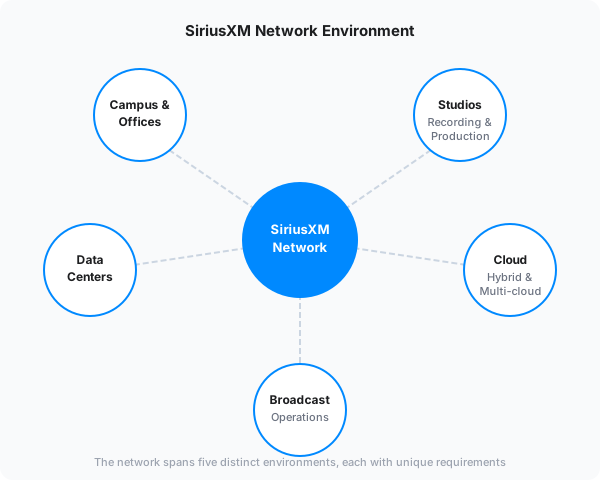
SiriusXM reaches around 170 million listeners monthly across a mix of live, on-demand, and curated programming. To support that, the network has to work everywhere at once: offices, studios, broadcast operations, data centers, and cloud. It’s a genuinely complex environment, and that complexity is the honest starting point for anything I say about network strategy.
My intro on stage was something like: “My team supports connectivity across offices, studios, broadcast operations, data centers, and cloud, so the network has to deliver both a great user experience and the resiliency our media operations depend on. Increasingly, we’re also operating more like a software team, where AI-assisted engineering and API-driven automation help us move faster.”
That last part drew some attention, which felt right. It’s where I think the real story is.
On How the Environment Has Evolved
The first question was about how our environment has changed and what pressures are shaping it today.
The honest answer is that the network has become more distributed, more experience-driven, and more business-critical, all at the same time. The traditional campus and office layer still exists and still matters. But layered on top of that are studios, broadcast workflows, hybrid cloud connectivity, and an employee base that simply expects things to work. Seamless connectivity isn’t a feature anymore; it’s an assumption.
The pressure isn’t just scale. It’s managing complexity without adding friction for the team. More tools, more integrations, more vendors. That’s not progress if the operations model gets slower or harder to understand.
The shift I called out specifically was how engineering work itself is changing. AI coding tools (I’ve written about Claude Code here before) have fundamentally changed how quickly a team can move from an operational problem to a working script or automation. That matters a lot more when your infrastructure exposes clean APIs. When it doesn’t, you’re still doing the same slow, manual work no matter how good the tooling is.
On Why the Platform Relationship Has Held
The second question was about what’s kept us aligned with HPE Networking as our strategy has evolved.
I’ve been in this industry long enough to be skeptical of vendor alignment for its own sake. What I said on stage was that we stayed aligned because the direction tracks what operators actually need: strong fundamentals, better visibility, more automation, and security that’s built into the architecture rather than bolted on later.
The piece I emphasized was the API story. An open, API-friendly foundation isn’t just a technical nicety. It’s what determines whether modern AI-assisted workflows can actually connect to real operations. If the infrastructure is accessible in a clean, controlled way, teams can move faster on automation, troubleshooting, and validation. If it’s a closed box, complexity just compounds.
On Tangible Impact
Third question: what’s one measurable improvement or meaningful outcome?
I stayed in safe territory here and talked about visibility and speed to resolution. When a user or site reports an issue, getting to root cause faster has a compounding effect. It improves the user experience directly, but it also changes how the team operates. Less time firefighting means more time on proactive architecture and improvement work.
The framing I’ve been thinking about is that AI-assisted workflows compress the low-level work. Telemetry, configuration, testing, documentation: a lot of the repetitive, manual steps in that cycle get shorter. For infrastructure teams, that’s a real force multiplier. The time savings show up in mean time to resolution, fewer repeat tickets, and faster rollout of changes.
On the Next 12–24 Months
The last question was about forward-looking priorities.
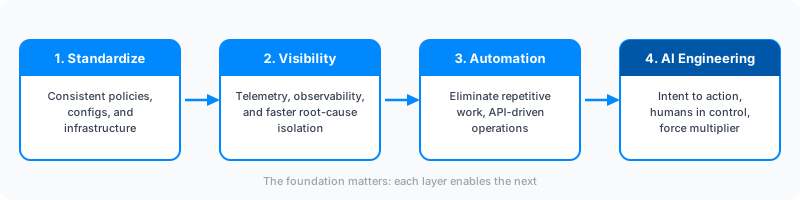
My answer: simplification at scale. More consistency across environments, more automation around repetitive work, a stronger security posture built into the network foundation rather than treated as a separate project.
The theme I kept coming back to is that the foundation matters because without it, AI and automation can’t deliver what they promise. If your network and toolchain are standardized and API-accessible, then AI-assisted engineering can help the team move from intent to action faster, while still keeping humans in control. That’s where I think the next real gains are.
The One-Liner
At the end, the moderator asked each of us for one sentence of advice for peers modernizing their networks.
Mine: “Our environment got more complex and more business-critical. We stayed aligned because we needed better visibility, automation, and security built into the architecture. The payoff has been faster resolution and better operator efficiency. Next, we want to simplify at scale.”
Yes, that’s technically four sentences masquerading as one thought. I know. But it’s the arc, and I’d rather say the whole thing than leave half of it on the table.
Good event. Good room. The best panels are the ones where the audience can tell the panelists are speaking from experience and not from a slide deck. I hope that came through.